01 / 10
Novapunks Dispatch — Issue 002

THE
PARALLEL
ECONOMY

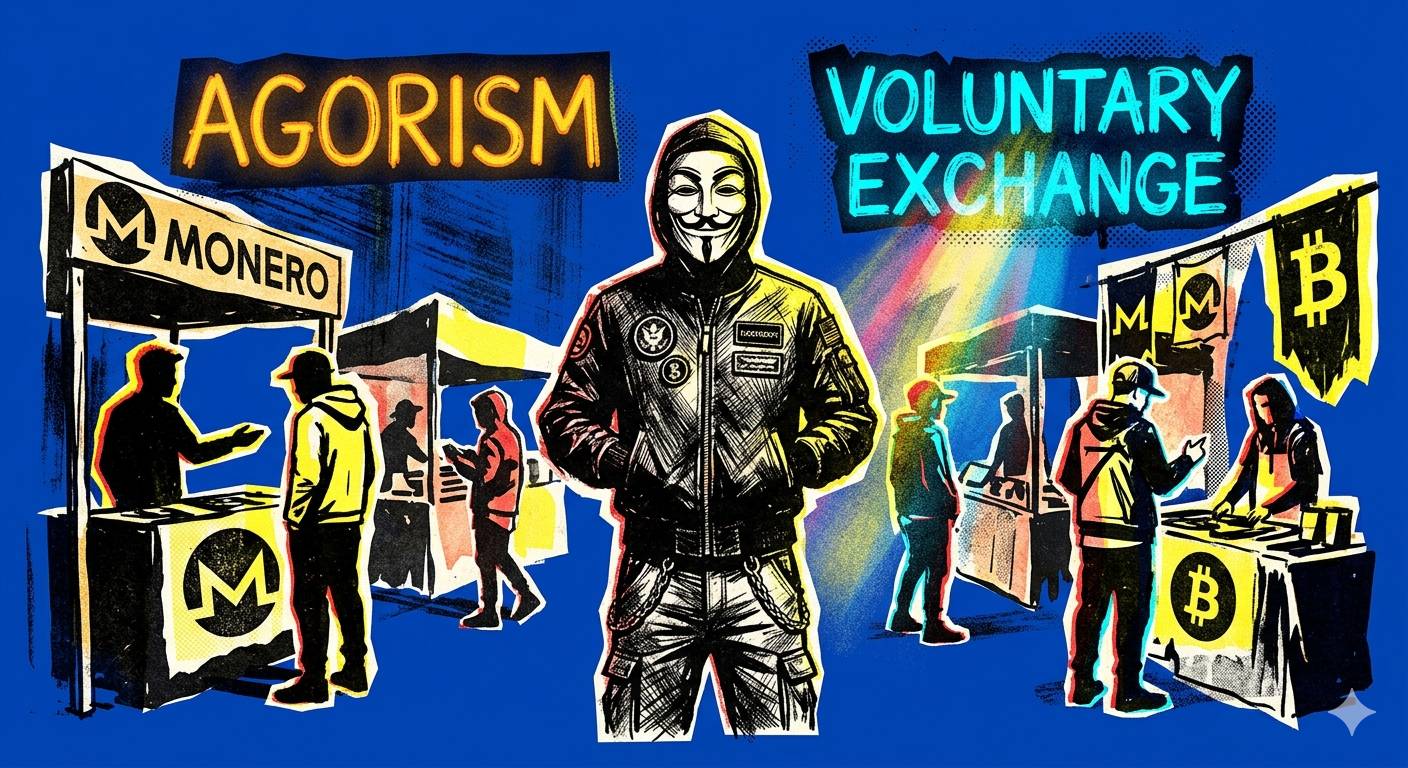
Agorism. Monero. DeFi. Underground markets. Sound money. The counter-economy is not theory — it is already operating, and growing with every voluntary transaction that leaves the coercive order behind.

02 / 10
Origins

Konkin's Vision:
The New Libertarian

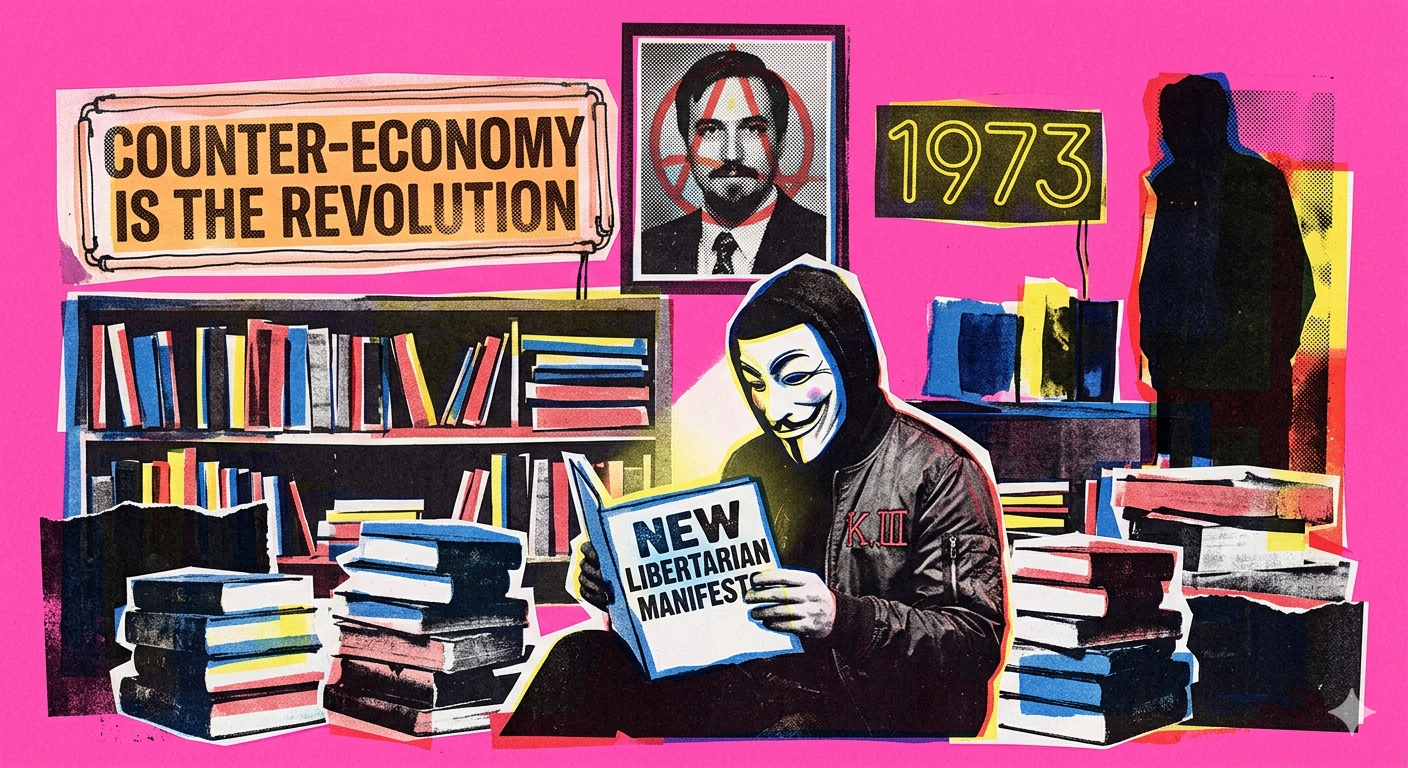
Samuel Edward Konkin III did not want to vote his way to freedom. Writing in the late 1970s from a cramped apartment in Long Beach, California, Konkin arrived at a conclusion that remains radical today: that the state cannot be reformed, only bypassed. His theory — agorism — named for the Greek agora, the open marketplace — held that the path to a free society ran not through electoral politics but through economic counter-action.

The agorist framework is elegant in its simplicity. Every transaction that occurs outside state control is a small act of secession. Every grey-market exchange — unlicensed, untaxed, ungoverned — removes resources from the coercive apparatus and builds the infrastructure of a parallel world. Konkin called this the "counter-economy," and he believed it would grow until the state simply became irrelevant, unable to fund itself, unable to enforce its rules against a population that had learned to route around it.

He was writing before the internet, before public-key cryptography, before Bitcoin. He was imagining the possibility; we are living the reality. The tools Konkin lacked — private communication, pseudonymous identity, cryptographic money — now exist. Agorism went from philosophy to infrastructure. What was once an idea for patient radicals is now a live system processing billions of dollars in voluntary transactions daily, governed by mathematics rather than men with guns.

The insight that makes agorism endure is its rejection of the adversarial frame. You do not need to defeat the state. You need to make it unnecessary. Every time someone uses Monero instead of a surveillable bank account, every time a developer is paid in crypto across jurisdictions without a financial intermediary's permission, the counter-economy grows and the old order's grip weakens by exactly that amount. Konkin understood that freedom is not a political outcome. It is an economic practice.

03 / 10
Private Money

Monero:
Digital Cash

Bitcoin is a public ledger. Every transaction, every address, every movement of funds is permanently visible to anyone with a node. This was a deliberate design choice — Nakamoto wanted trustless verification — but it creates a surveillance surface that governments, analytics firms, and hostile actors exploit aggressively. Chain analysis is now an industry. Bitcoin is pseudonymous at best; with sufficient metadata, it is often not even that.

Monero was built to be cash. Its core innovations — ring signatures, stealth addresses, and RingCT — make every transaction unlinkable and untraceable by default. There is no opt-in privacy mode. There is no transparent view for compliance. The sender, receiver, and amount are cryptographically hidden in every single transaction. This is not a bug. It is the design.

Ring signatures obscure the sender by mixing their transaction output with others from the blockchain, making it computationally infeasible to determine which input is the real one. Stealth addresses generate a one-time address for each transaction, meaning no two payments to the same recipient share an address. RingCT hides transaction amounts using Pedersen commitments — verifiable to network participants as valid without revealing the actual figures. Together, these properties make Monero the only major cryptocurrency that fulfills the basic requirements of money as understood by anyone who has ever used physical cash.

Governments know this. Several exchanges have delisted Monero under regulatory pressure. The IRS offered $625,000 contracts to firms that could break its privacy. None have. Monero's resilience is not a claim — it is a track record. The continued failure to crack it under enormous institutional incentive is the best proof-of-work any privacy technology can offer.

04 / 10
Decentralized Finance

DeFi and
the Unbanked

There are 1.4 billion adults in the world without a bank account. This is not an accident. Banking infrastructure is expensive to build and maintain. The populations most excluded from it are those living in politically unstable regions, those without formal documentation, those whose transaction volumes are too small to be profitable for institutions optimizing for returns. The global financial system was not designed for them. It was designed despite them.

Decentralized finance operates differently. A lending protocol on Ethereum does not ask for your passport. A stablecoin does not require a credit score. A decentralized exchange does not enforce geographic restrictions. The barrier to entry is internet access and a wallet address — both increasingly available even in the most resource-constrained environments. This is not charity. It is architecture. DeFi's permissionlessness is a property of the code, not a policy choice that can be reversed by a board vote.

The implications are structural. A woman in a country where women cannot legally own bank accounts can hold assets in a non-custodial wallet. A freelancer in a high-inflation economy can hold USDC rather than a currency that loses 40% of its value annually. A remittance worker can send money home for a fraction of a percent rather than the 6-8% charged by Western Union and its peers. These are not edge cases. They are the primary use cases for hundreds of millions of people who have never been the target market for traditional finance.

DeFi is not without risk — smart contract exploits, oracle manipulation, and poorly audited code have cost billions. But the risks of the existing system — arbitrary account freezes, capital controls, inflationary monetary policy, political seizure of assets — are born silently by billions who have no alternative. DeFi at least fails transparently, and its failures can be fixed by open-source code rather than closed-door policy decisions.

05 / 10
Counter-Economics

The Gray
Market Economy

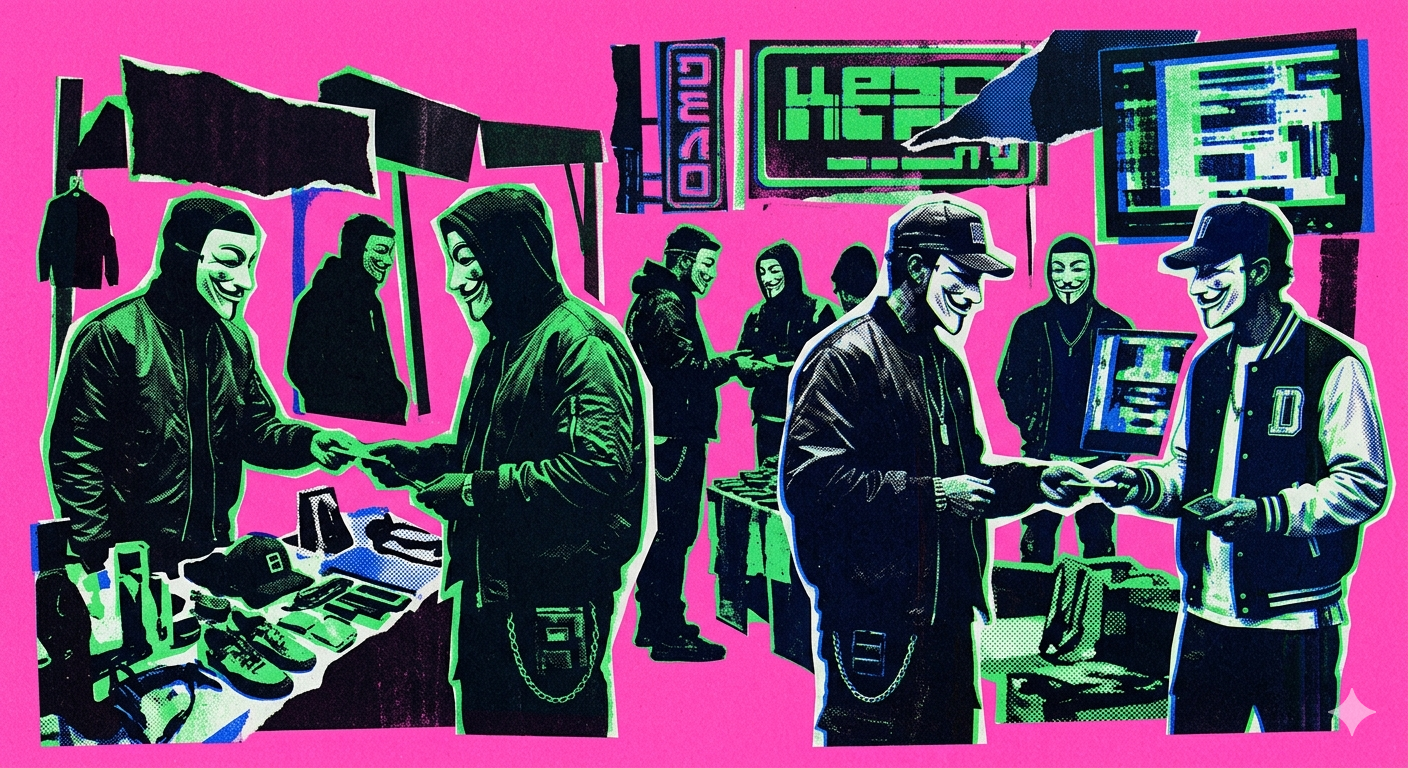
The gray market is not the black market. It is not fencing stolen goods or trafficking contraband. It is the vast, expanding space of economic activity that exists outside official systems not because it is criminal but because official systems have failed, overreached, or simply not reached. Street vendors, unlicensed tutors, informal repair shops, peer-to-peer currency exchange, unregistered freelancers — this is the gray economy, and in most of the world it represents between 20% and 60% of all economic activity.

What crypto does to the gray economy is the same thing the mobile phone did to African banking: it provides infrastructure. The informal economy has always operated on trust, local reputation, and physical proximity because it lacked access to financial rails. Crypto provides those rails without requiring participants to register with institutions that would either refuse them or report them. The result is an explosion of economic activity that was previously bottlenecked by geography and access.

In Argentina, where the official peso has lost over 90% of its value in recent years, an entire parallel dollar economy has operated informally for decades. Crypto has not replaced this — it has supercharged it. USDC and USDT now function as shadow currencies for millions who use them to price goods, hold savings, and settle debts outside a financial system they have learned, through hard experience, not to trust. The government has attempted to restrict crypto access. The population routes around it the way water routes around rock.

Venezuela, Nigeria, Turkey, Lebanon — everywhere fiat money has failed catastrophically, crypto adoption has surged not as a speculative investment but as basic economic survival infrastructure. The gray economy was always there. Crypto gave it a backbone. The parallel economy is not a niche product for technologists. It is what human beings do when official systems stop serving them.
06 / 10
Monetary Theory

Sound Money:
From Hayek to Bitcoin

Friedrich Hayek's 1976 book Denationalisation of Money proposed something that seemed eccentric at the time: that governments should lose their monopoly on currency issuance, and that competing private currencies would emerge, with the best money winning adoption through superior stability and trustworthiness. Central banks dismissed it. Economists called it unworkable. Hayek was writing a thought experiment about a future nobody expected to arrive.

Bitcoin arrived. It did not arrive as Hayek imagined — it is not issued by competing banks but by a decentralized protocol — but it realized his core insight with more precision than even he expected. A currency whose supply is fixed by mathematics. A monetary policy that cannot be changed by a committee meeting in secret. An asset that cannot be debased by political decision. Sound money, in its purest possible form.

The Austrian critique of inflationary monetary policy runs as follows: when governments print money, they transfer wealth from savers to debtors — primarily from ordinary citizens to large institutions and the state itself. This hidden tax, called the inflation tax, falls hardest on those without access to assets that appreciate alongside money supply. The wealthy store value in real estate, equities, and commodities. The poor store it in bank accounts and cash. Inflation is a regressive wealth transfer disguised as monetary policy.

Bitcoin's fixed supply of 21 million units is the technical implementation of the Austrian monetary argument. Its halvings — the programmatic reduction of new supply every four years — create a predictable scarcity schedule that no central authority can override. Its adoption as legal tender in El Salvador and increasing corporate treasury adoption are not aberrations. They are the beginning of the monetary competition Hayek predicted: a world where people choose their money rather than having it imposed on them.

07 / 10
AI Markets

Bittensor
and AI Markets

The next frontier of the counter-economy is not human labor — it is machine intelligence. Artificial intelligence is rapidly becoming the most economically significant technology in human history, and like every other significant technology, it is being captured by a small number of centralized actors: OpenAI, Anthropic, Google DeepMind. The compute infrastructure that trains frontier models costs hundreds of millions of dollars. The data that trains them was gathered by surveillance capitalism. The outputs are being locked behind APIs and subscription walls.

Bittensor is the attempt to route around this capture. It is a decentralized network in which machine learning models compete to provide the best AI outputs, rewarded in TAO tokens by a market mechanism rather than a corporate evaluation process. Miners serve AI model outputs. Validators assess quality. Rewards flow to those producing the most useful intelligence. No single entity controls the network. No single entity can be pressured to censor its outputs.

The implications extend beyond AI. Bittensor represents a generalizable architecture: any market for digital commodities — compute, storage, bandwidth, intelligence — can be organized as an open protocol with token-based incentives rather than as a corporate service. The parallel economy is not limited to goods and labor. It encompasses the production and distribution of intelligence itself.

08 / 10
Decentralized Exchange

The DEX
Revolution

Centralized exchanges are honeypots. They hold your keys, your coins, and your identity documents, and they will hand all three to any government that asks politely enough. FTX, Celsius, Mt. Gox, Quadriga — the history of centralized crypto exchanges is a history of catastrophic failures, customer funds lost, and trust destroyed. The custodial exchange model imports all of the fragility of traditional finance into a system that was designed to be trustless.

Decentralized exchanges operate differently. Uniswap, Curve, dYdX, Thorchain — these protocols allow users to trade directly from their wallets, peer-to-peer, with no intermediary holding funds. The protocol is the exchange. The smart contract is the custodian. You retain control of your keys throughout the transaction. There is no signup. There is no KYC. There is no counterparty risk from a company that might go bankrupt or get hacked.

The automated market maker model — pioneered by Uniswap — replaced the traditional order book with a constant-product formula. Liquidity providers deposit asset pairs into pools. Traders swap against these pools at prices determined by the ratio of assets. It is elegant in its simplicity: a market that operates 24/7, requires no market makers, can list any token instantly, and runs entirely on public code that anyone can audit.

The DEX share of crypto trading volume has grown from negligible to significant over five years. It accelerates every time a major centralized exchange collapses. The pattern is consistent: trust in custodians erodes, DEX volume spikes, new users learn that self-custody is not complicated. The DEX revolution is not technological evangelism. It is the market learning from repeated experience that intermediaries fail, and that code can be trusted where companies cannot.

09 / 10
Practical Agorism

Agorism
in Practice

"The counter-economy is not a future aspiration. It is a present practice. Every voluntary trade outside the state's permission is a vote for a different world."

Konkin's theory was always meant to be lived rather than merely read. Agorism without practice is just another political philosophy gathering dust. The practical application breaks down into four overlapping domains: what you earn, what you hold, how you transact, and who you build with.

What you earn: wherever possible, bill in crypto. Accept payment for work in Bitcoin, Monero, or any private coin. This is not about speculation. It is about receiving value in a form that does not require you to beg permission from a bank to access, that cannot be frozen at a bureaucrat's request, and that does not automatically generate a report to your tax authority. The shift is gradual. The accumulated effect is structural.

What you hold: never hold more than you need in bank accounts. Keep an emergency fund in a non-custodial wallet. Explore stable stores of value — Bitcoin for long-term savings, privacy coins for liquid spending. Physical gold and silver have served human beings for 5,000 years. A diversified sovereign portfolio mixes digital and physical assets held directly, not on someone else's platform.

How you transact: use Monero for privacy-sensitive purchases. Use peer-to-peer markets where available. Trade skills and services within trusted networks without involving financial intermediaries. Build local economic relationships that do not depend on platforms that can be pressured or deplatformed. Every layer of redundancy you build into your economic life is resilience against future coercion.

Who you build with: the counter-economy is a social project. Connect with others who share this orientation. Build trusted networks. Create value for people who share your values. The agora was always a community before it was an economic system. The modern parallel economy is the same: it runs on trust, reputation, and shared commitment to voluntary exchange. Find your agora. Build it deliberately.

10 / 10
The Horizon

The Economy
After the State

The end state of the parallel economy is not utopia. It is a world in which the state's ability to extract value from people without their consent has been so thoroughly degraded by technical means that it can no longer sustain itself at its current scale. This does not require a revolution. It requires sufficiently widespread adoption of tools that make coercion unprofitable.

We are not there. We are nowhere near there. But the direction is clear. Every year, more economic activity moves into the counter-economy. Every year, privacy-preserving tools become more usable, more accessible, more embedded in everyday life. Every year, a new generation enters adulthood for whom crypto is not a novelty but a financial native environment.

The parallel economy will not replace the official economy overnight. It will grow alongside it, as the shadow grows alongside the tree. The question is not whether it will grow — it will — but whether you will be part of it. Whether you will build in it, earn in it, transact in it, and pass it to those who come after you as something better than what you inherited.

The counter-economy is not a side project. It is the main project. Build it deliberately. Use it consistently. Teach it generously. The economy after the state begins with the choices you make today.