01 / 10
Novapunks Dispatch — Issue 003

THE
NETWORK
STATE

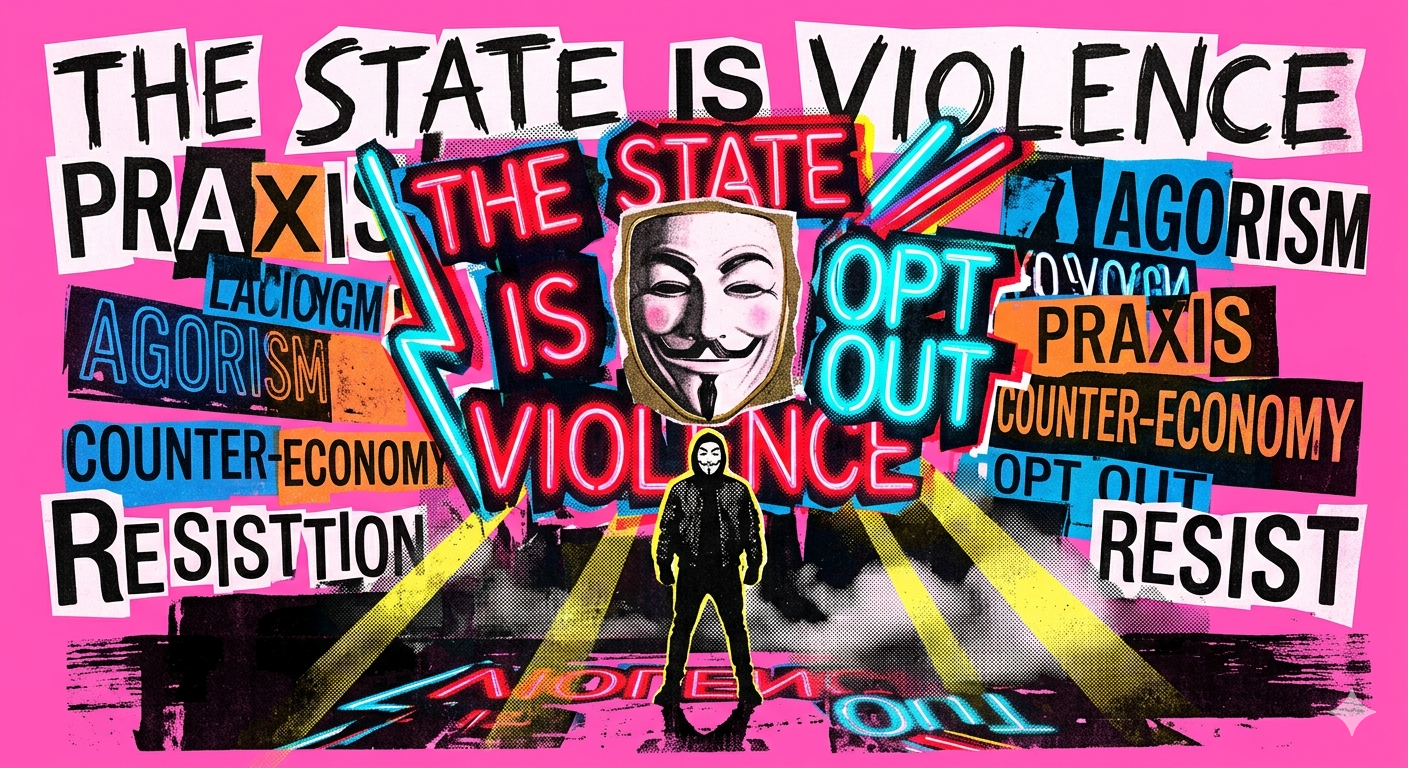
Nation-states are failing. Exit over voice. DAOs as governance. Digital citizenship. The next institutions are being built online, run by code, and governed by those who choose to participate.

02 / 10
Political Theory

Exit
Over Voice

Albert Hirschman's 1970 treatise Exit, Voice, and Loyalty described three responses to institutional decline: exit the institution, voice dissatisfaction within it, or remain loyal regardless. Traditional political theory has spent centuries theorizing about voice — about elections, petitions, referenda, social movements, and the mechanics of making the powerful listen. The result is a politics of permanent dissatisfaction: the machinery of voice is captured by those who benefit most from the status quo, and the dissatisfied are kept perpetually engaged in processes that rarely produce change.

The cypherpunk insight — and the agorist insight — is that exit is not retreat. Exit is the most powerful vote available. When enough people exit an institution, they do not merely register dissatisfaction; they withdraw the resources that allow the institution to continue functioning. Exit is what the market does to bad products. Exit is what history does to empires that stop serving their subjects. Exit is structural, not symbolic.

The digital age has made exit cheaper than it has ever been. You can exit the banking system with a hardware wallet. You can exit the surveillance internet with Tor and Signal. You can exit the credentialed knowledge economy with open protocols and decentralized reputation systems. You can exit the nation-state's financial jurisdiction with crypto in a way that required a Swiss bank account and a seven-figure balance in the previous century. The tools of exit have democratized. The question is whether the will to use them will follow.

Balaji Srinivasan's concept of the Network State extends this logic into political organization itself. If a community can assemble online, build shared values, develop internal governance, accumulate wealth, and eventually crowdfund physical territory, then the nation-state monopoly on legitimate governance is not an inevitability — it is a temporary function of high coordination costs. Lower the cost of coordination enough and new polities become possible. The internet lowered those costs. Blockchain lowered them further. Network states are what happens next.

03 / 10
New Institutions

DAOs as
Governance

A Decentralized Autonomous Organization is the attempt to encode governance in smart contracts rather than in legal documents, bylaws, and the threat of state enforcement. The idea is as old as the blockchain itself — Satoshi's consensus mechanism is, in a primitive sense, a DAO — but the form has matured significantly. MakerDAO governs a $5 billion stablecoin system. Uniswap's DAO controls one of the largest DEX protocols. ENS DAO manages the Ethereum Name Service. These are not experiments. They are live governance systems processing real decisions with real economic consequences.

The innovation is not decentralization for its own sake. It is the separation of governance from geography. A traditional corporation is governed by the laws of its jurisdiction of incorporation, enforced by courts, and ultimately backed by the coercive power of the state. A DAO is governed by code, enforced by the blockchain, and backed by the economic incentives of its token holders. This means a DAO has no headquarters to raid, no executives to arrest, and no bank accounts to freeze. Its operation cannot be suspended by a hostile government without shutting down the underlying blockchain entirely — which would require capturing the majority of global mining or staking power.

DAOs are not perfect. Governance participation is typically low. Plutocratic dynamics — where large token holders dominate voting — emerge naturally. Coordinating across time zones and cultures without a shared institutional culture is difficult. But these are problems of social organization, not of the technology. They are problems that human organizations have always faced, now visible in public on-chain rather than hidden in boardrooms. The DAO is not the finished form of decentralized governance. It is the first working prototype.

04 / 10
Identity

Digital
Citizenship

Citizenship, as currently constructed, is the most powerful social lottery on earth. The country of your birth determines your access to healthcare, education, freedom of movement, legal protection, and economic opportunity more than any other single variable — including your intelligence, work ethic, or character. This is not a controversial observation. It is a measured fact: Branko Milanović's research shows that approximately 60% of the variance in global income is explained by citizenship alone. You do not earn citizenship. You are assigned it at birth.

Digital citizenship is the attempt to decouple membership in a community from the accident of geography. Your ENS domain is your digital identity — portable, pseudonymous, sovereign. Your on-chain reputation is built through your actions rather than your paperwork. Your access to digital services is determined by your cryptographic keys rather than your national ID. In this model, you are not a citizen of a nation-state by birth. You are a member of multiple overlapping communities by choice.

Ethereum's account model — and its extensions like EIP-4337 account abstraction — are moving toward a world where your on-chain identity is as meaningful as your passport. Proof of humanity protocols, zero-knowledge identity systems, and decentralized reputation networks are building the infrastructure for a form of identity that is verifiable without being surveilled, portable without being stateless, and meaningful without being coercive. Digital citizenship is not a replacement for physical citizenship yet. But it is the architecture of something that could eventually compete with it.

The countries that understand this are already adapting. Estonia's e-Residency program. Portugal's crypto-friendly tax regime. El Salvador's Bitcoin citizenship pathway. These are early experiments in governance innovation — polities competing for talent and capital by making their digital infrastructure attractive. Network states will accelerate this competition by offering governance primitives that no legacy nation-state can match: transparent rule of law, programmable incentives, and governance that updates in weeks rather than decades.

05 / 10
Institutional Decline

Nation-State
Failure

The nation-state was the dominant political technology of the 20th century. It mobilized populations for industrialization, organized mass armies, built welfare states, and provided a relatively stable framework for international relations through a system of mutual recognition. For a period — roughly 1945 to 1990 — it performed these functions tolerably well in the developed world. That period is over.

The structural failures are now visible across every dimension. Fiscal: Western governments carry debt loads that have no historical precedent in peacetime, sustained only by central bank money creation that cannot continue indefinitely without destroying the purchasing power of the currencies in which the debts are denominated. Institutional: trust in democratic institutions has collapsed to historic lows in every major developed democracy, measured consistently across two decades of polling. Competence: the response to COVID-19, the failure to control inflation following the post-pandemic stimulus, the inability to build basic infrastructure on any reasonable timeline — these are not anomalies. They are evidence of calcified bureaucracies that cannot adapt.

The political scientist Francis Fukuyama diagnosed the problem as "political decay" — the tendency of democratic institutions to be captured by entrenched interest groups who use them to extract rents rather than provide services. James Scott's concept of "high modernism" describes the tendency of large states to impose legibility on complex social systems, destroying local knowledge and adaptation in the process. The nation-state's failures are not accidental. They are structural features of an organizational form that scales badly, adapts slowly, and concentrates power in ways that invite abuse.

This is not an argument for anarchism in the pejorative sense — for no governance at all. It is an argument that the organizational form of governance matters enormously, and that forms that were optimal for 1950 may not be optimal for 2030. The question is not whether governance is necessary. The question is which governance technologies will prove most capable of organizing human cooperation at scale without becoming extraction machines. The answer is almost certainly not the nation-state in its current form.

06 / 10
Institution-Building

Parallel
Institutions

The Grameen Bank demonstrated in Bangladesh that financial services could be delivered to the rural poor without the infrastructure of a conventional banking system. Khan Academy demonstrated that education could be delivered to anyone with an internet connection without the infrastructure of a school. Wikipedia demonstrated that encyclopedic knowledge could be produced and maintained without the infrastructure of publishing. In each case, the parallel institution did not defeat the existing institution in direct competition. It simply served the people the existing institution was not serving, and grew from there.

Parallel institutions in the crypto era follow the same logic. Compound and Aave provide lending services to anyone without a banking license. Mirror Protocol provided publishing infrastructure to anyone without a media company. Arweave provides permanent data storage to anyone without a server farm. These are not startups competing in the existing market. They are new markets serving new participants with new rules.

The parallel institution strategy has a political advantage over direct confrontation: it does not require the permission of those whose power it eventually displaces. A cypherpunk asking a government to reform its surveillance apparatus is likely to be ignored. A developer building better privacy infrastructure is building regardless of what governments think. The parallel institution accumulates power through adoption, not through persuasion. By the time the established institution recognizes the threat, the parallel system is too embedded to dislodge.

The playbook for the next decade of institution-building is clear: build the parallel financial system (already underway), the parallel identity system (underway), the parallel media and information system (early stages), the parallel educational credentialing system (early stages), and eventually the parallel governance system. None of these need to win a fight. They need only to grow — serving the underserved, building reputation, developing robustness — until exit becomes a reasonable choice for enough people that the old institutions must change or become irrelevant.

07 / 10
Legal Theory

Polycentric
Law

Monocentrism in law holds that a single sovereign — the state — must be the ultimate source of legal authority within a territory. This view is so embedded in political culture that most people cannot imagine an alternative. But it is historically recent, practically contested, and theoretically fragile. For most of human history, most human beings lived under overlapping and competing legal systems: canon law, common law, merchant law, tribal custom, and guild rules all operated simultaneously, with individuals selecting applicable systems based on context. The monocentric state is a modern invention.

Polycentric law — the theory developed by Bruno Leoni, Michael Polanyi, and later elaborated by legal theorists like Tom Bell and Randy Barnett — holds that legal order can emerge from competition among private rule systems rather than from monopoly public authority. Parties choose their governing rules. Disputes are arbitrated by mutually agreed bodies. Reputation systems enforce compliance where coercion cannot reach. This is how international commercial law already functions: there is no world government enforcing contracts between parties from different jurisdictions, yet billions of dollars of transactions are completed reliably every day under private arbitration systems that predate any international treaty.

Smart contracts are the first implementation of polycentric law at scale. When two parties agree to a Uniswap trade, they are not relying on any legal system to enforce the agreement. The contract enforces itself. There is no arbiter, no court, no compliance officer. The rules are written in code, visible to all parties before they transact, and executed automatically. This is a form of private law — chosen by participants, transparent in its terms, self-enforcing in its operation — that has more in common with medieval merchant law than with the regulatory state.

08 / 10
Seasteading & Charter Cities

Cloud Cities:
The Physical Tier

The network state is not purely digital. Balaji Srinivasan's formulation culminates in physical territory — land crowdfunded by the community, recognized diplomatically by existing states, providing a physical anchor for a community that began online. This is the charter city concept updated for the crypto age: not a corporation buying land from a government, but a community accumulating social capital online and then converting it into political capital offline.

The precursors are already operating. Próspera in Honduras is a ZEDE — a Special Economic Development Zone — with its own legal system, its own regulatory environment, and its own startup-style governance. It operates under Honduran sovereignty but with a distinct set of rules negotiated by contract rather than imposed by the national legislature. Singapore and Dubai are earlier, larger versions of the same idea: polities that compete for talent and capital by offering superior governance infrastructure rather than simply extracting from their existing populations.

Seasteading — the Patri Friedman and Peter Thiel project — proposed the ocean as a governance frontier: platforms in international waters beyond any state's jurisdiction, free to experiment with governance systems. The engineering proved harder than expected, and no permanent floating city has yet been established. But the underlying insight — that governance should be competitive and that the ability to experiment requires exit from existing jurisdictions — has moved from fringe to mainstream in the governance innovation community.

The network state bridges these traditions. It starts where the internet makes organization cheap — building community, culture, and capital online — and ends where sovereignty requires physicality: in land, in recognition, in the ability to protect members from external coercion. The digital and physical are not competitors. The digital tier organizes the community; the physical tier legitimizes it. Together, they describe a new institutional form that neither the nation-state nor the corporation can fully replicate.

09 / 10
Identity & Belonging

Post-National
Identity

"Nationalism is the belief that the most important thing about a person is which side of an arbitrary line they were born on. We can do better."

The nation is an imagined community. Benedict Anderson's phrase, from his 1983 book of that name, is precise: nations are not natural formations. They are collective fictions maintained by shared narratives, symbols, rituals, and media systems. The German who has never met another German feels a bond with them because both have been told — through schoolbooks, anthems, flags, and news — that they share something essential. This fiction has been enormously powerful. It has organized the most effective political structures in human history. It has also organized the most destructive wars in human history.

Post-national identity does not mean having no identity. It means constructing identity from chosen affiliations rather than inherited ones. Your values, your community, your commitments, your culture — built deliberately over a lifetime rather than assigned at birth by the lottery of geography. This is not a new idea. Cosmopolitanism has a long philosophical lineage. What is new is the infrastructure that makes chosen community genuinely viable at scale.

The cypherpunk community is itself an example of post-national identity in operation. Its members span dozens of countries. They share a set of values — privacy, freedom, cryptographic sovereignty — more than they share a language, ethnicity, or territory. The community built institutions (PGP, Tor, Bitcoin) more durable than those of many nation-states. Its culture spread through ideas rather than immigration. Its members recognize each other across jurisdictions without flags or borders.

The novapunk is the updated version of this: someone for whom digital tools are native, whose community is global and chosen, whose political affiliation is to principles rather than states, and whose economic participation is routed around rather than through legacy institutions. Post-national identity is not rootlessness. It is belonging to multiple communities simultaneously, with the depth of commitment determined by the individual rather than the state. This is not alienation from community. It is its highest form.

10 / 10
The Horizon

The Shape of
What Comes Next

The network state will not arrive as a revolution. It will arrive the way the internet arrived: gradually, then suddenly. First as a curiosity — a small community with shared values and a token. Then as an institution — with governance, dispute resolution, and economic activity. Then as a polity — with territory, diplomatic recognition, and the ability to protect members. The transition from each stage to the next is not predetermined. It requires builders, participants, and people willing to commit to something that does not yet fully exist.

The forces working against this transition are real. Established nation-states will not cede authority willingly. The regulatory apparatus targeting crypto is not an accident — it is an attempt to slow the exit. The culture of compliance, of institutional deference, of learned helplessness before bureaucracy, runs deep. These are not trivial obstacles. They are the accumulated weight of a system that has had centuries to consolidate its legitimacy.

But the direction of travel is set. The tools for exit exist. The communities organizing around them are growing. The intellectual frameworks — from cypherpunk to agorism to network state theory — are mature. The economic case for parallel institutions grows stronger every year that the existing ones fail more visibly. What is lacking is not possibility. What is lacking is urgency and intention.

The network state begins with the recognition that the future will not be delivered by legacy institutions. It will be built by people who understood, early, that governance is a technology like any other — improvable, forkable, replaceable — and who chose to build something better rather than wait for reform that was never coming. That recognition is available to anyone, right now. The question is what you do with it.